

from the breadboard to the PCB
Developing circuits and components with breadboards is hands down the best way to develop a concept circuit from scratch. Where the exact design is not defined, building out and testing the circuit on a breadboard allows you to make infinite changes while receiving instant feedback from the oscilloscope and other outputs, logs to serial etc.
In the case of the ultrasonic scanner (FC1), breadboard development was exactly what was needed. It allowed me to develop prototypes, redesign with new components, and experiment until I was happy I had a solid foundation from which I could test the concept and collect data in the field.
Prototype established, it can be drafted up quickly in a circuit design software, and from this an initial PCB designed. PCB printing services are common and with fast lead times (1-5 business days), prototypes can be turned around incredibly quickly.
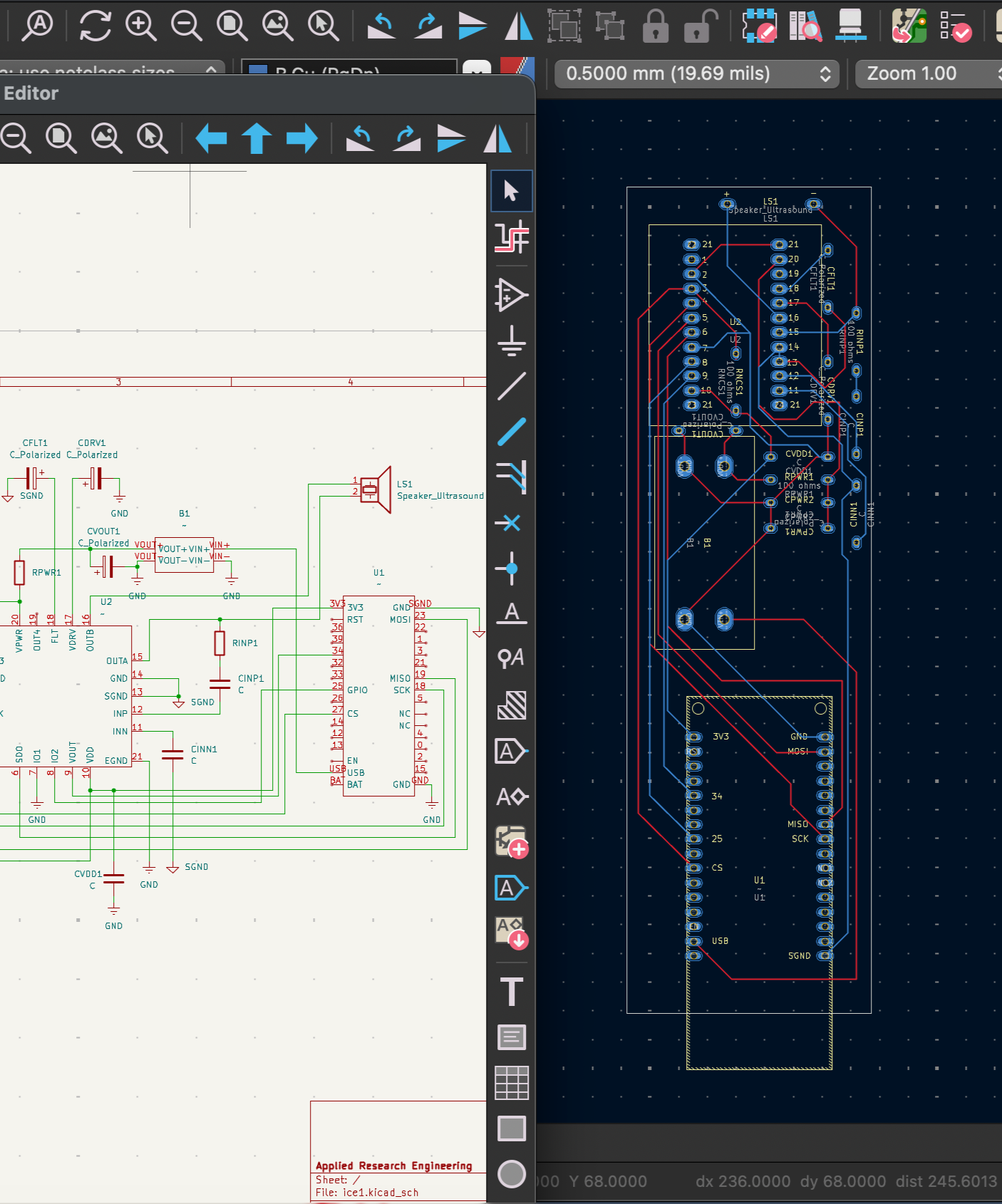
Circuit diagram schematic for FC1 prototype, with initial PCB layout on the right.
The PCB has 2 layers, allowing separation of some of the analog and digital signal carriers. The long portrait outline is so that it can fit easily in the handle of the casing, with the transducer connected at the top of the circuit.
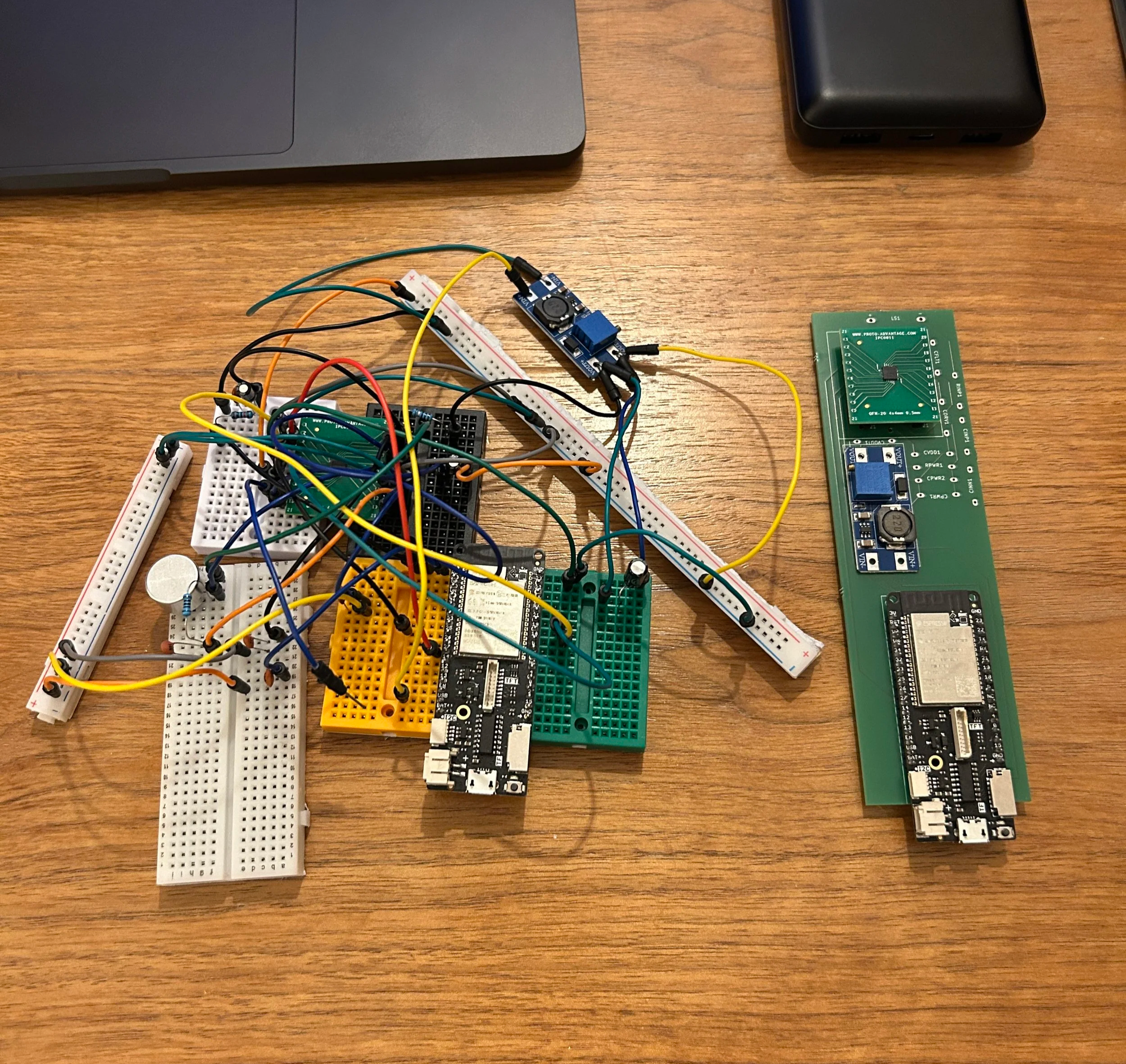
From the breadboard to the PCB.
The messy appearance of a breadboard prototype can often become restrictive - at this point it’s often sensible to move to a prototype board where you can solder your connections to achieve a cleaner and more permanent board.
One step further than a prototype board is the printed PCB on the right, which represents a similar (if not more complex) circuit albeit without resistors and capacitors soldered. Despite this PCB being fairly verbose, it is clearly massively more concise than the breadboard prototype.
Tomorrow I will be flying out to the Canadian High Arctic Research Station to work with Real Ice Development Company on their mission to thicken arctic sea ice with engineering solutions. Testing the FC1 ultrasonic device will make up a small part of my schedule, with the rest dedicated to helping the team in their efforts to thicken the ice, and the research they are doing alongside it.